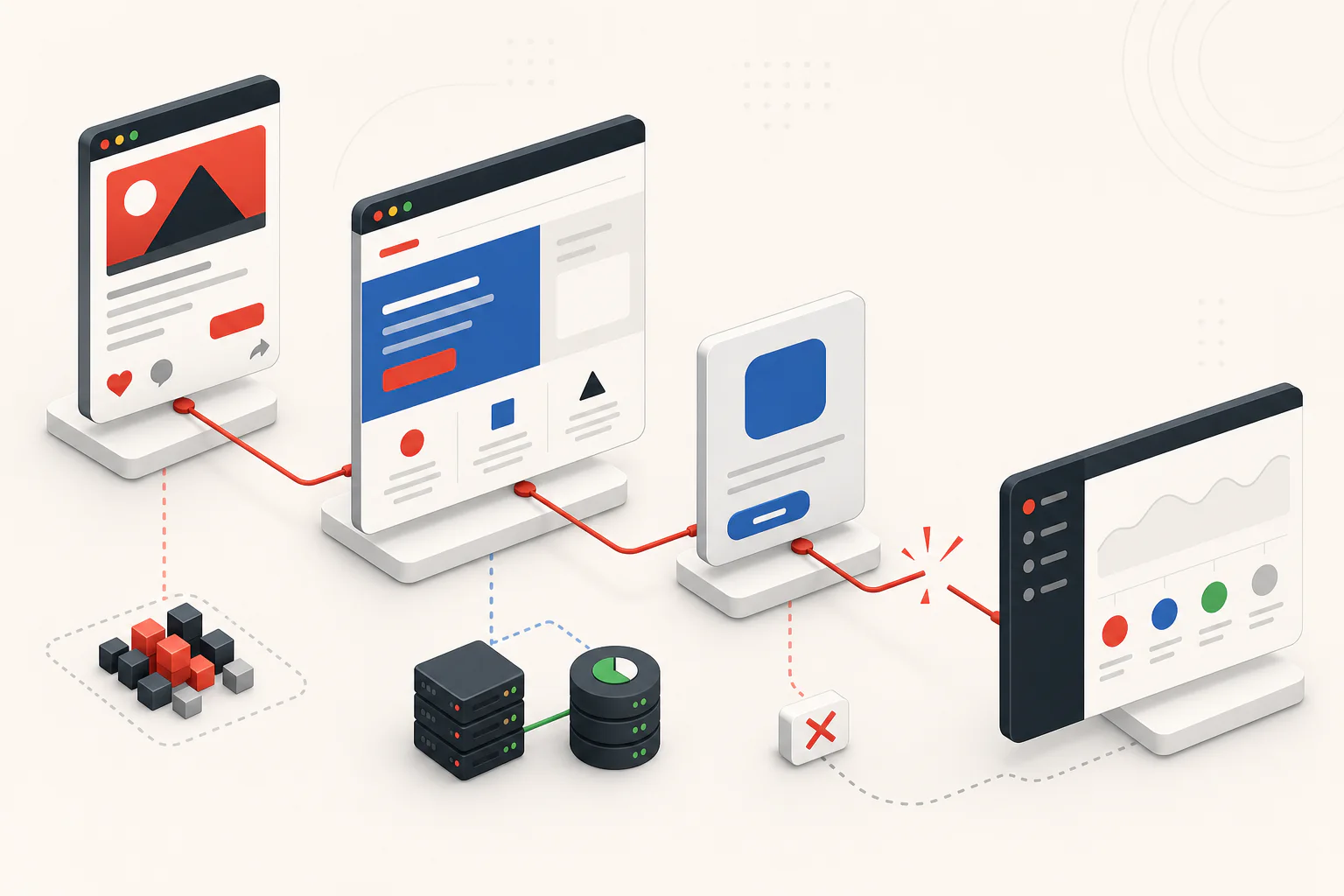
A perfectly tagged app campaign can still send people to a blank screen. At that point, the attribution model is not inaccurate. It is irrelevant. The customer never reached the store.
This is the trap in app-download marketing: the link has two jobs that look like one. It must survive the browser or social app that launches it, and it must carry enough information for the measurement you want afterward. Marketers often debate URL parameters while assuming the first job is already solved. That assumption can erase the conversion before tracking even begins.
Prove the route before measuring it
A store URL working in Safari does not prove it will work inside Instagram, an email client, or another in-app browser. Each source controls part of the handoff. A destination can be valid and still fail when the source app tries to open it.
That makes route testing a campaign requirement, not a technical courtesy. Test the exact link from the exact placement on the devices that matter. A bio link, a marketer-controlled links page, and a button on a website are different paths even when they end at the same store listing.
A temporary external-browser handoff can help when an in-app browser fails, especially when it sits on a page the marketer controls. But a workaround that functions from a website may be rejected as a direct bio URL. More importantly, the normal route may start working again after the source app changes. The available observations do not establish a permanent Instagram rule; they show a temporary failure, mixed workaround behavior, and a later return to ordinary links.
So treat the workaround as incident response. Keep a fallback, retest the standard link after updates, and remove extra routing when it no longer earns its complexity.
Decide which conversion you mean
Once the route works, ask a deceptively simple question: are you measuring the store click or the eventual install?
A click from your website can be recorded before the redirect. That tells you which campaign, page, or button sent somebody toward a store. It does not automatically connect the browser visit to an install or first app open. That second journey needs a mobile attribution method capable of carrying or joining the campaign identity beyond the store.
The operating decision follows from the question:
- If the store click is the useful outcome, record the outbound event and preserve the campaign context you already control.
- If the install or first open is the useful outcome, design for that handoff explicitly rather than assuming ordinary web UTMs will complete it.
- If both matter, keep them as separate funnel stages so a routing failure does not masquerade as an attribution failure.
Android and iOS do not offer one identical campaign-link mechanism. The supplied guidance points to different store-side options and, in some cases, a mobile-measurement or smart-link layer. The lesson is not that every app needs another vendor. It is that copying the same web URL convention into both stores is not a measurement plan.
Build the launch checklist around failure
Before an app campaign goes live, verify four things in order:
- The exact link opens from every paid and organic placement you will use.
- A controlled fallback exists for source-app browser failures.
- The team agrees whether the KPI is a click, an install, or a first open.
- The attribution path is appropriate for the store and the chosen KPI.
Then repeat the first test after major source-app changes. A link that worked at launch is not guaranteed to keep working, and a temporary patch is not guaranteed to remain necessary.
App marketers do not merely own a URL. They own a chain of handoffs between a placement, a browser, a store, and an app. Measure the step you actually need—but first make sure the customer can reach it.