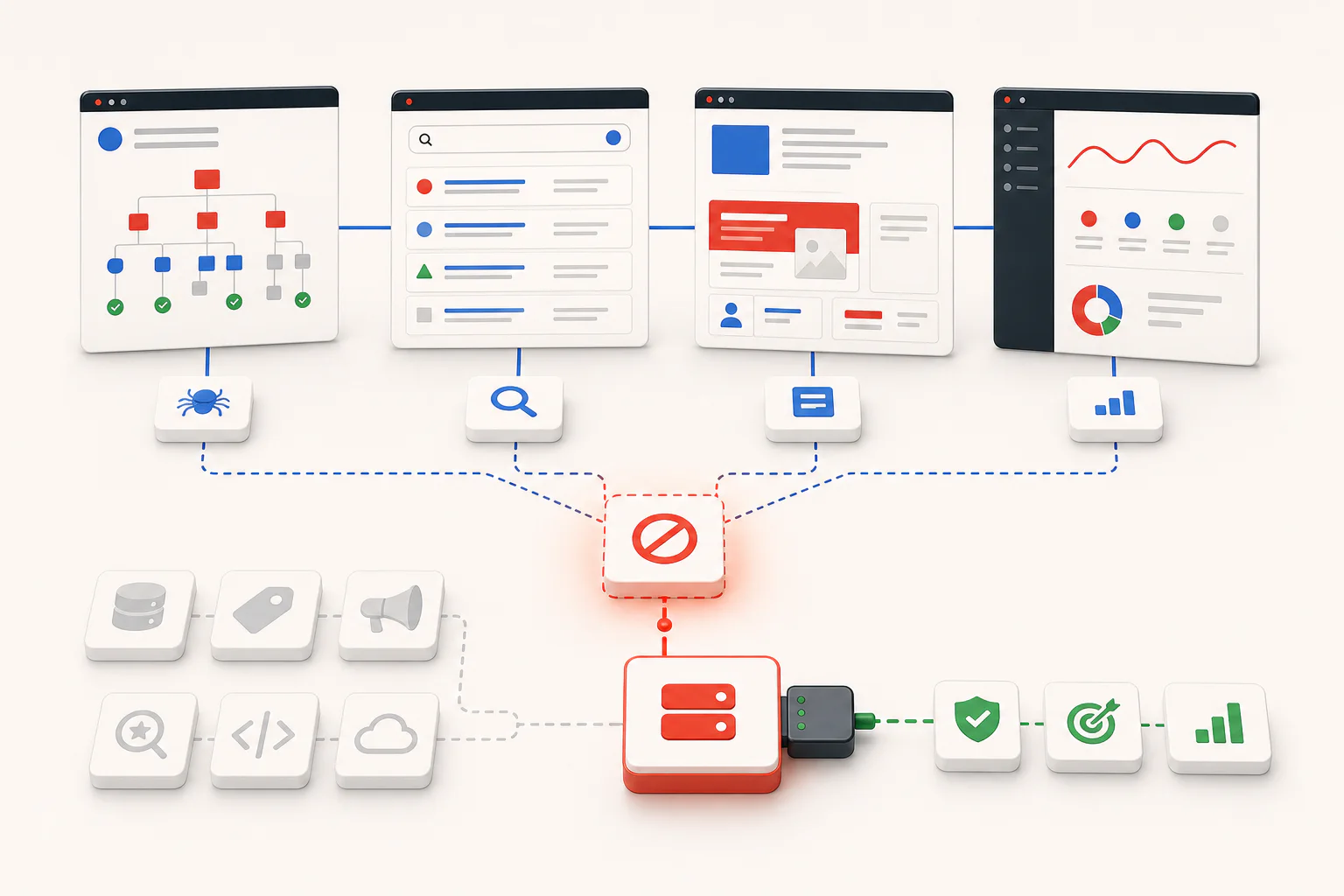
The most expensive SEO tool is not always the subscription with the highest price. It is the one that fills dashboards without changing next week's work.
Software comparisons usually begin with indexes, limits, features, and coverage. Buying should begin somewhere less glamorous: the decision the team has to make again and again. A tool earns its place when it makes that decision faster, clearer, or more reliable. Everything else is rented possibility.
Start with the decision, not the category
SEO is too broad to produce one best-value tool. A content team choosing which pages to refresh does not have the same operating problem as an agency producing local visibility reports for many clients. Both may need SEO software, but they are not buying the same job.
Name the repeated decision first. It might be which page deserves attention, which technical issue should be fixed, which market has room to grow, or whether a client needs intervention this week. Then ask what evidence is missing and how often that gap delays action.
This exposes feature theater quickly. If nobody owns the workflow, no recurring decision depends on it, and no action follows from the report, the feature is not capacity for later. It is a cost today.
A modular stack is the honest default
For a small operation, first-party search data, a crawler, and one focused paid layer can cover more useful work than an all-in-one suite used at ten percent of its breadth. The point is not that free or cheaper tools are equivalent. They are not. The point is that depth only matters where the team repeatedly needs it.
A modular setup also makes the next purchase easier to justify. If backlink research is the missing decision input, buy depth there. If client reporting consumes delivery time, solve that. If location tracking drives the work, choose for that requirement. Each addition answers a visible failure rather than a fear of missing features.
The inconvenience is real. Data lives in different places, reports need assembly, and the team has to understand what each source measures. But inconvenience is not automatically a reason to consolidate. It becomes a reason when it repeatedly steals time from work the business values.
The suite wins when coordination becomes the bottleneck
An integrated platform can be the cheaper choice when several active workflows cross multiple clients. Shared permissions, templates, alerts, tracking, and reporting may replace enough manual coordination to justify the subscription. At that point, the comparison is no longer premium software versus cheap software. It is software versus labor, delay, and inconsistency.
There is a countertradeoff. Technically capable teams can lower direct data costs with pay-as-you-go access and a custom interface, but they take responsibility for setup, maintenance, usage control, and changes in the data source. Cheap data can support an expensive process. A polished suite can automate a process that never needed to exist.
There is no universal break-even point. The right threshold depends on how often the work occurs, how much coordination it requires, and what happens when the decision arrives late.
Make the subscription prove it replaced work
Every SEO tool should have an operating receipt. Which recurring decision improved? What manual step disappeared? What action became possible that was previously blocked? If the team cannot answer after a reasonable trial, the subscription has failed even if the product is excellent.
This creates a useful upgrade rule and an equally useful exit rule. Buy more software when a documented bottleneck is costing more than the solution. Reduce it when reports trigger no action, advanced data never changes priorities, or the team keeps exporting everything into another system before it can think.
At the end of the trial, ask what the team now decides faster and which manual step disappeared. If the answer is nothing, cancel the subscription—even if the dashboard looks impressive.