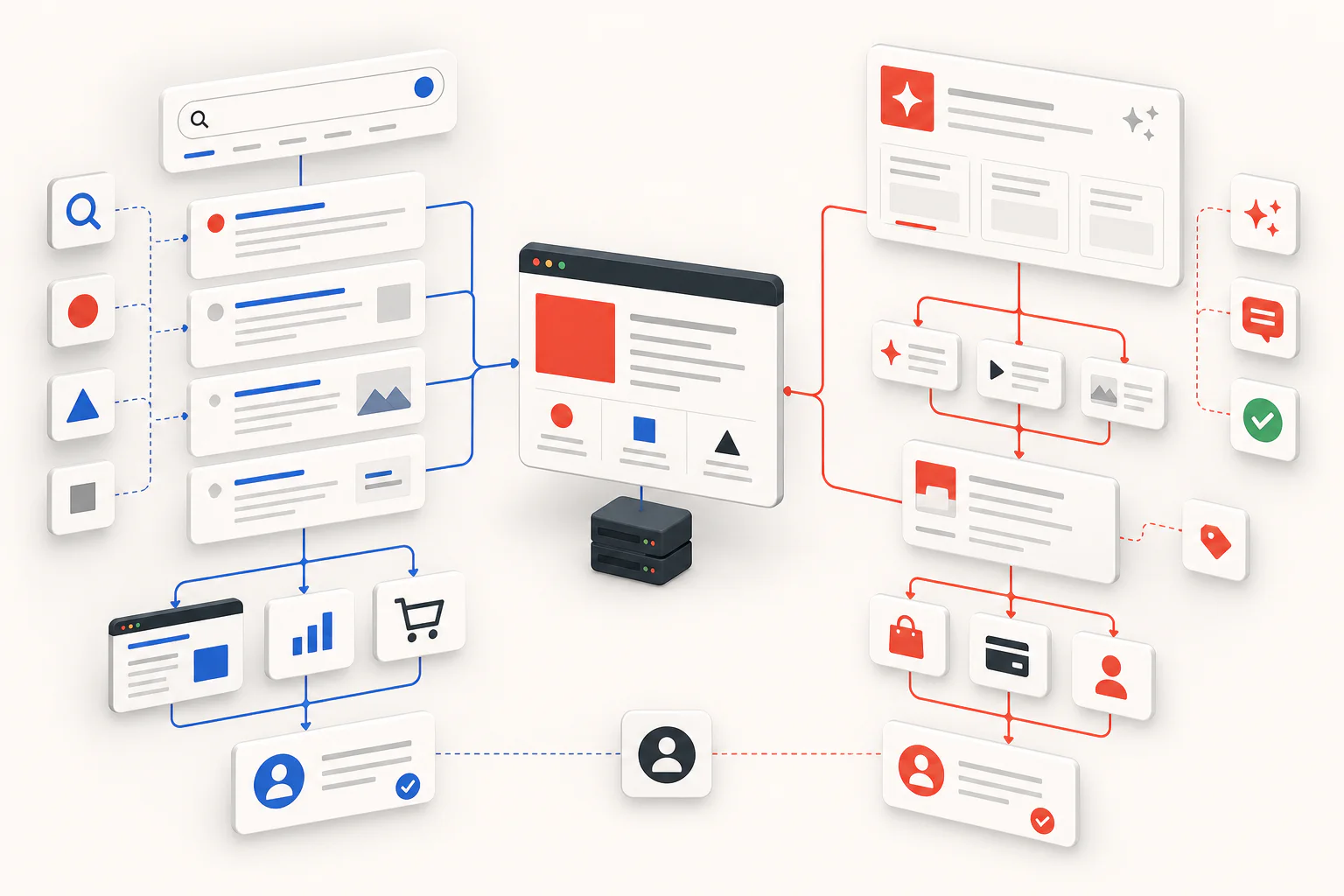
Google visibility and AI recommendations are not one score. A brand can improve on one surface while losing ground on another, and the commercial result can move with the difference.
That split is the only reason AEO deserves its own line in a marketing plan. If the work is merely clearer pages, stronger authority, better structure, and more useful answers, it is SEO with a new label. A separate discipline becomes useful only when it reveals a commercial disagreement that ordinary search reporting cannot see.
Most AEO work is still SEO
The sensible default is skepticism. Pages still need to answer real questions clearly. A site still needs to be understandable, technically sound, and credible. Accurate mentions beyond the company website still matter. None of that became new because AI products began assembling answers.
This makes many AEO proposals easy to test. Remove the acronym and ask what will actually change. If the answer is improved content, schema, links, or authority, the work may be valuable, but the budget should be judged as SEO work. A new name is not evidence of a new operating problem.
The distinction matters because labels create spending before they create decisions. A team can add another dashboard, another visibility score, and another monthly report without learning anything that changes where it invests.
The exception is a split result
The exception appears when the systems disagree. A reported agency experiment found that changing listicle placement improved Google and AI Overview visibility while ChatGPT and Perplexity citations fell, along with the leads associated with them. The result challenges the comfortable belief that stronger Google performance is a reliable proxy for stronger AI visibility.
It is still a bounded case, not a universal law. It does not prove that listicle placement has the same effect for another brand, prompt, category, or AI product. It proves something narrower and more useful: rankings alone cannot settle whether a brand is being recommended elsewhere.
That is where AEO stops being a rebrand. Its job is not to produce another visibility number. Its job is to find material differences between discovery systems, then show whether those differences reach customer behavior.
Treat each engine as a separate market
AI products do not have to retrieve the same pages, weigh the same signals, or describe a brand in the same way. A company may present itself clearly on its own site while comparison pages, reviews, listicles, and other outside material tell a different story. Improving one page does not guarantee a consistent answer everywhere.
So the useful unit of measurement is not AI visibility in the abstract. It is a defined buyer question, checked repeatedly in the products customers may use, with the cited pages and brand description recorded. That record then has to meet the outcomes the business already cares about: referrals, qualified leads, and revenue.
A single screenshot proves almost nothing. A trend can still be noisy, but repeated checks make disagreement visible. More importantly, they force the team to decide which engine and which customer question are important enough to act on.
Buy the disagreement, not the acronym
Most companies do not need to rebuild their search strategy around AEO. They need to keep doing durable SEO and add a separate measurement layer only when AI recommendations matter to the buying journey.
The budget becomes defensible when that layer exposes a gap: search performance improves, AI recommendations weaken, and a business signal moves with it. Until then, AEO is mostly a fashionable way to invoice familiar work.
Track one important buyer question across Google and the AI products your customers actually use. If the systems disagree and a business signal moves, investigate. If they do not, keep the acronym out of the budget.